Venue Tech, Security, and the Realities of “Go Live”

SEAT FEBRUARY ROUNDTABLE RECAP
Our February SEAT Monthly Roundtable was a practical, wide-ranging conversation about what it really takes to deploy and operate technology in live-event environments, especially when the stakes are highest and “testing” only goes so far.
Across venues, teams, and vendors, one theme kept coming up: the first big event is where the truth shows up.
When new tech meets its first major event
Roundtable members shared real-world examples of new rollouts hitting turbulence once crowds, volume, and game day pressure entered the picture. Ticketing changes, new venue builds, and tight timelines all amplify risk, and even thorough planning can miss issues that only appear at full scale.
A key takeaway was a simple but important approach to de-risk deployments: where possible, test new technologies in existing venues before introducing them into brand-new builds.
Cybersecurity without breaking the fan experience
Security posture and customer experience continue to be a balancing act. The group discussed how security teams are often asked to respond late in the process after purchases are already made, and the friction that creates for implementation timelines.
There was also candid discussion about vendor requests for broad firewall access. The practical guidance was to push for justification on port requirements and use DNS names where possible, rather than granting overly permissive access by default.
Converged networks, private 5G, and protecting mission-critical systems
We talked about the ongoing shift toward converged networks, paired with a strong reminder that mission-critical systems still need separation, whether that is private networks or dedicated CBRS layers for security and operations.
An important negotiation point came up as well: when working through carrier agreements, venues need to protect the ability to operate private CBRS networks and avoid unintentionally giving that up through exclusivity language.
Access control and credentialing: the people side is the hard part
Facial recognition and modern access control capabilities are advancing quickly, but implementation often comes down to training, consistency, and enforcement on the ground.
There was also a notable gap discussed between security teams and digital credentialing workflows, with too many venues still relying on paper processes and physical tokens alongside digital systems.
Ticketing fragmentation is becoming a fan pain point
We dug into the growing frustration fans feel when a single weekend requires multiple apps, multiple logins, and inconsistent authentication flows. The tension is clear: leagues and venues want to “own” the experience, but forcing proprietary app journeys can introduce unnecessary friction compared to established ticketing platforms.
AI is moving fast, especially in operations
AI has rapidly shifted from theory to practical implementation in venue environments. The group discussed real operational use cases, including routing critical communications to the right staff, and using AI to turn SOPs and event documentation into something part-time staff can actually access and follow during live operations.
We also explored how “agentic” AI tools are lowering the barrier for non-coders to build useful applications in natural language, accelerating what teams can prototype and deploy.
Emergency response and proactive threat detection
The conversation highlighted high-priority scenarios venue leaders are actively planning for, including lost children, active threats, and other security incidents. Participants also called out limitations in current 911 routing for large venues and opportunities for more targeted emergency messaging and credentialed responder alerts.
We also discussed where the market is heading: moving beyond reactive detection (like gunshot detection alone) toward proactive identification of threats and suspicious behavior patterns.
Community updates: research, access, and ongoing roundtables
Josh Barney also shared updates on the partnership with Infotech and the introduction of an “Export Alley” style experience at SEAT Charlotte, helping organizations schedule time with subject matter experts.[1]
Monthly roundtables continue to be a core Membership benefit, designed to keep the community learning and sharing year-round, not just during conference week.
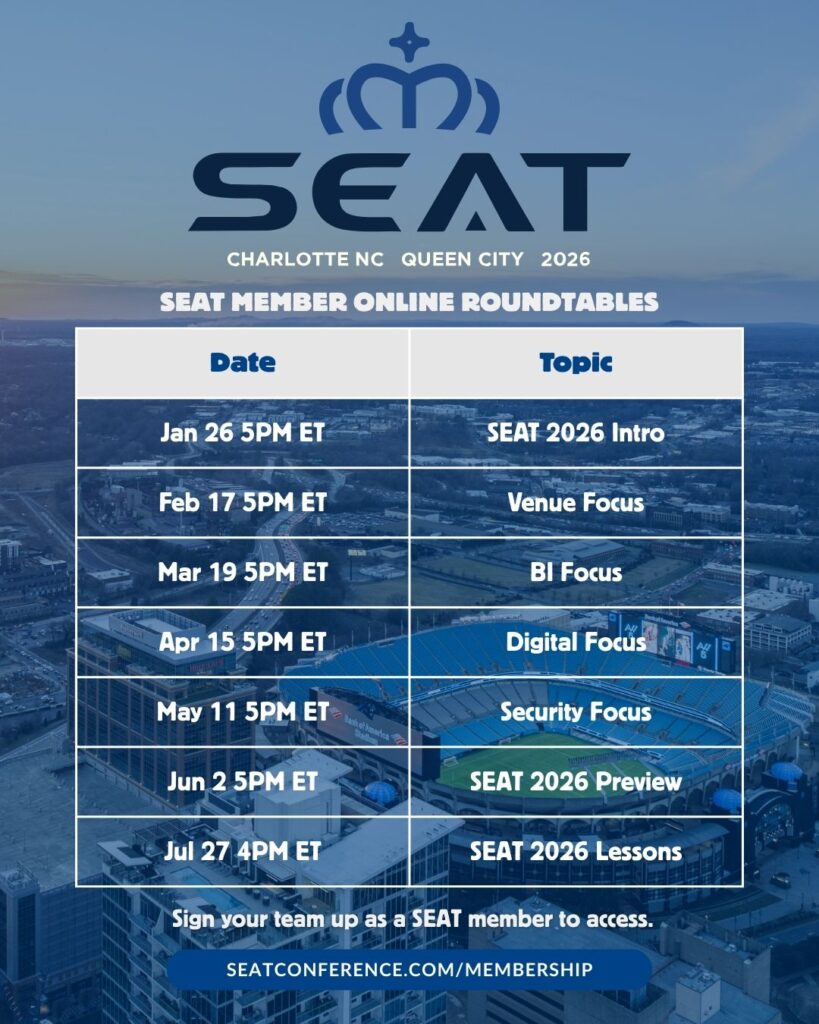
Next SEAT Member Roundtable will be March 19 5PM ET with a focus on Business Intelligence.
Become a SEAT Member
If you want more of these real conversations, the answer is simple: be part of the community that shapes them.
SEAT Membership is the clearest way to plug in. It is designed for teams, venues, and universities that want year-round access, plus a straightforward path to Charlotte 2026.
If SEAT is “your people,” do not wait until June to reconnect.
If your organisation is not yet a SEAT member, you can sign up below.
See you at the next roundtable,
2026 SEAT Member Roundtable Schedule